Creative | The Merchant · Issue № 001
Small print, big label.
Article 50 asks advertisers a question studios and agencies have spent years avoiding: which parts of this are real?

By Mick Dicken, Head of Creative Studio

This painting is AI-generated.
It's a fairly well-known fact that advertising has always had a comfortable relationship with the unreal. We all know the burger on the telly doesn't look like that in real life, but it still tastes alright, so do you really care? Like old Tudor paintings, it seems we've spent a lifetime of product advertising agreeing that a photograph of a product is more or less a flattering account of the subject, rather than God's honest truth. It's a wonder tighter rules took even this long, especially given the precedent set in 1539 by the portrait of Anne of Cleves, of which the account was apparently so flattering that Cromwell lost his head over it. The fact of the matter in modern times, however, is that flattery has, until AI, usually stopped short of being an outright lie.
Recent developments in Generative AI have blurred distinctions even further, and on 2nd August the European Union finally set a firm legal precedent. Article 50 of the AI Act now applies to ads within the European market.
Unlike lucking out and starting with Australia in Risk, geography won't save you here. The Act binds providers and deployers outside the EU if any of the ads being shown feature in the European market. A Manchester agency generating creative for a client whose Meta delivery reaches Dublin is still liable. Office location is irrelevant.
What counts as a deepfake & the death of product photography.
Product photography as many knew it: the studio day, a photographer, a stylist, a retoucher on the invoice, has been quietly leaving mid-market briefs for years ever since Nano Banana got good enough at not destroying a product label. Not necessarily always the campaign work, but certainly on the future volume: the seasonal re-dress or the fourteen lifestyle contexts a listing needs and nobody will ever look at closely. It's all generated now. A serviceable image in thirty seconds and no meaningful cost beats pretty much anything akin to it, and the customer scrolling past simply cannot know anymore. My mother said to me recently that she noticed she was seeing fewer and fewer AI-generated images and videos, and I had to explain that it's not that there are fewer, but instead that it's unfortunately getting harder and harder to tell what's real and what's a deepfake.
Deepfake is a word that a lot of marketers dismiss, because until now the media has generally deemed a deepfake to mean either a fabricated politician or a stolen face, and not someone selling a bottle of soap. Article 3(60) is broader than this. It defines a deepfake as an AI-generated or manipulated image, audio or video content resembling existing persons, objects, places, entities or events, which would falsely appear to be authentic.
What falls outside the new law is the outright ridiculous or impossible. The Commission's guidelines cite dragons and unaided human flight. If nobody could reasonably mistake it for a real photograph or a video, it is not a deepfake. So you can rest easy that your AI slop talking fruits TikTok dramas are safe.
There are hazier lines, however. A real product photographed against an AI-generated background is treated as not within the article's definition. An AI image that makes the product look better than it really is falls inside it and requires disclosure. The test, in other words, is not whether a model was involved. It's whether the result legitimately misrepresents whatever product is being sold. It's a distinction that will likely feel familiar to anyone who has worked in a studio before. It's roughly the line between set dressing and lying. Putting the bottle on a beach that does not exist is standard production. Falsely generating a bottle whose liquid runs a richer amber than the real formulation, or whose label sits flatter and cleaner than anything that ever came off a press, is a claim about the product.
Label your work.
Complying with the new law is, on the face of it, quite simple and easy. A line saying something to the effect of "AI-enhanced image", small yet readable, is generally fine. Video takes a single label at the head of the file. It's worth noting as well that this also covers synthetic voiceovers. The Commission has helpfully published a voluntary icon set alongside its Code of Practice on transparency, distinguishing wholly generated from partially modified content, and a standard mark is easier to apply consistently across a client base than letting every brand invent its own phrasing.
An important thing not to gloss over is that accuracy matters more than you might think with labels. If the product itself is generated rather than photographed, calling the image "enhanced" understates what happened and misdescribing it is just asking for trouble. Better to say the environment is generated and the product genuine and genuinely mean it. Written copy is also exempt. Text triggers disclosure only when published to inform the public on matters of public interest, and even then human editorial review lifts the obligation. Advertising copy is neither.
For those brave enough, Article 50(4) offers an escape route. It suggests lighter treatment for deepfakes that form part of an evidently artistic, creative, satirical or fictional work, allowing disclosure in the accompanying material rather than on the face of it. Many businesses will be tempted. They should resist. The final guidelines read the exception narrowly, hold that the informative character prevails where content mixes the two, and classify every advertising example they give as requiring standard labelling.
The AI label as a negative status symbol.
Ask a premium brand to put "AI-enhanced image" in the corner of its hero image. Go on. Please, I don't want to. The objection won't be a legal one. It'll be that the line looks cheap, announces a shortcut, sits badly next to a price point built on provenance. And they're right to worry; we've already seen what the alternative looks like.
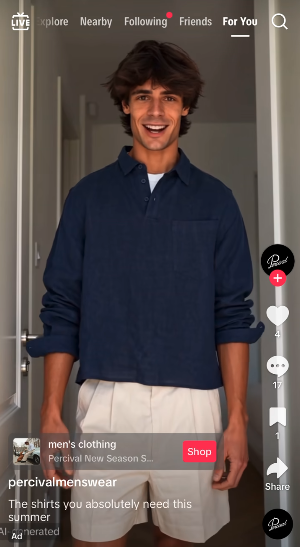
Earlier this summer, Percival, a London menswear label with a following built almost entirely on the strength of its art direction, appeared on TikTok as an obviously AI-generated man, captioned "the shirts you absolutely need this summer", with an AI-generated tag sitting under it. From what I could see before the ads were pulled, all of the comments were negative, stating exactly what you might expect from those expecting a higher-class brand to use their own resources and budget to show off the actual clothes. The fact of the matter here, however, is that nobody at Percival had designed it. Nobody had approved it. According to Declan Etheridge, who (according to this LinkedIn comment) runs paid media for the brand, TikTok's update had applied AI suggestions to a published ad and then quietly loaded more in the background. It was caught quickly and pulled with limited spend behind it, but the response in the comments was immediate and entirely predictable: this is not what we thought we were buying.

When Guess ran AI-generated models in Vogue last summer, a disclosure line was included in the fine print. The criticism affected both the magazine and the brand. One creator's verdict on the ad was simply that it didn't make her want to buy anything, which is the single worst sentence a campaign can produce.
It's worth contemplating. Whilst Percival didn't decide to use AI, the reputational cost landed on the brand, because it always lands on the brand. I'd predict that premium labels won't become more hesitant about AI in the abstract. They'll still use it constantly, in mood boards, in pre-visualisations, but it's likely what they'll refuse is using it anywhere a customer can see the seams, and the label's whole reason for existing is to point the customer to exactly where those seams are.
Summing up.
The obvious response to all this is to say: 'well, nobody will be caught', and I'd imagine many businesses and agencies alike are waiting in the wings to see how many of their competitors will see how far they can get away with this. National market surveillance authorities only have finite budgets and a queue of other biometric systems to worry about. But enforcement risk is a poor reason to do anything, and an even worse reason to skip it. The label costs nothing. With fines of around €15m or 3% of worldwide annual turnover (whichever is higher), what it buys is the total security of both your brand's respectability and of your legal standing.
References
Written by
Mick DickenMick leads Lifeblood's Creative Studio, overseeing the strategy, design and production of performance creative at scale. He works at the intersection of brand building and direct response, with a particular focus on how AI is reshaping the way brands look and sound.
Written by hand, in Cornwall.
Subscribe
Get The Merchant delivered free to your inbox each month.
A publication by
One issue a month
More from Issue № 001
All issues →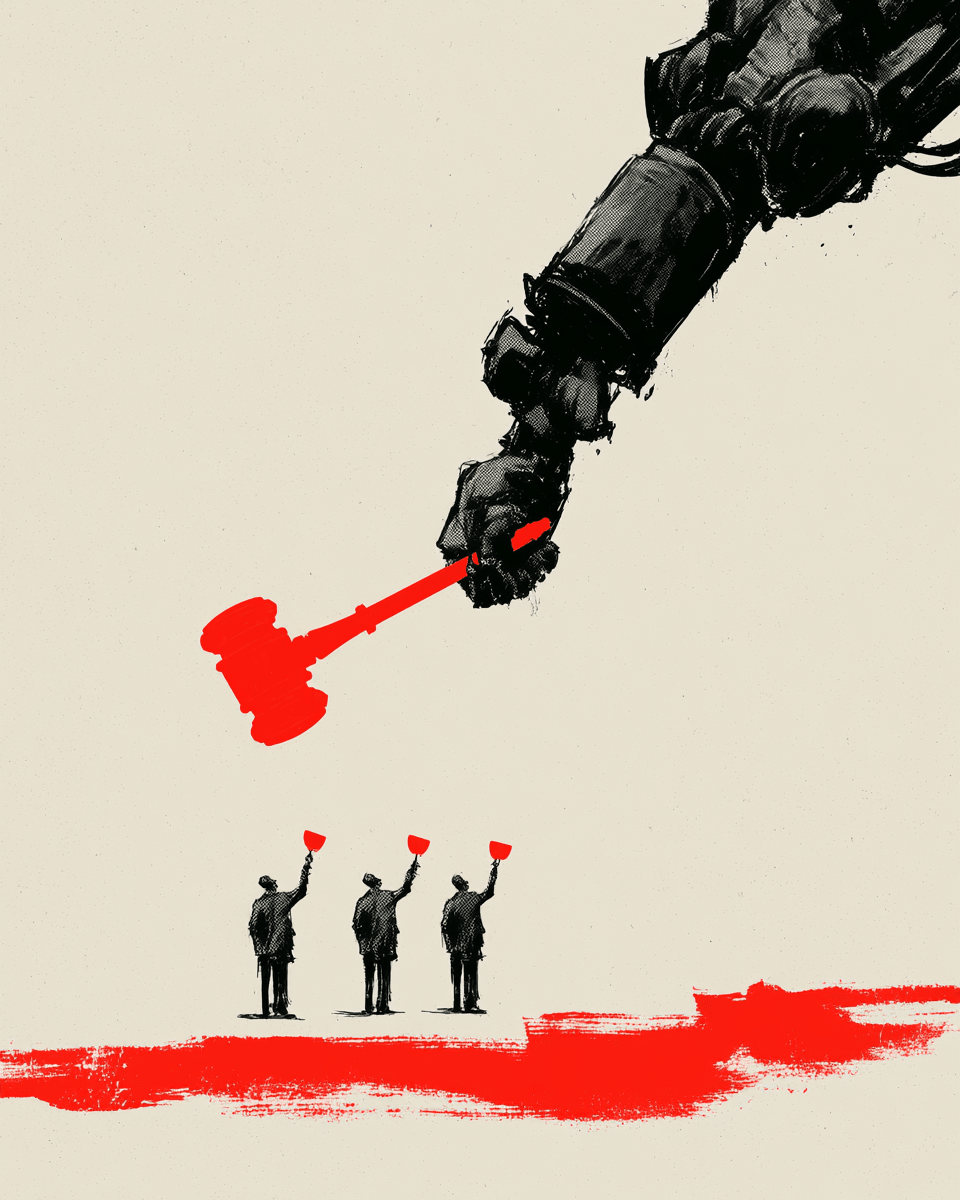 № 001 · The lead
Josh Fletcher
Meta / Meta Ads for DTC brands: inside the multi-stage architecture powering ad ranking and sequencing.
In August, Meta's engineers published the blueprint for how every ad on its platforms is ranked. Almost nobody in the industry read it.
 № 001
№ 001Jack Paull
Meta / The 5 counter-intuitive quirks of Meta Ads - and what to do about them.
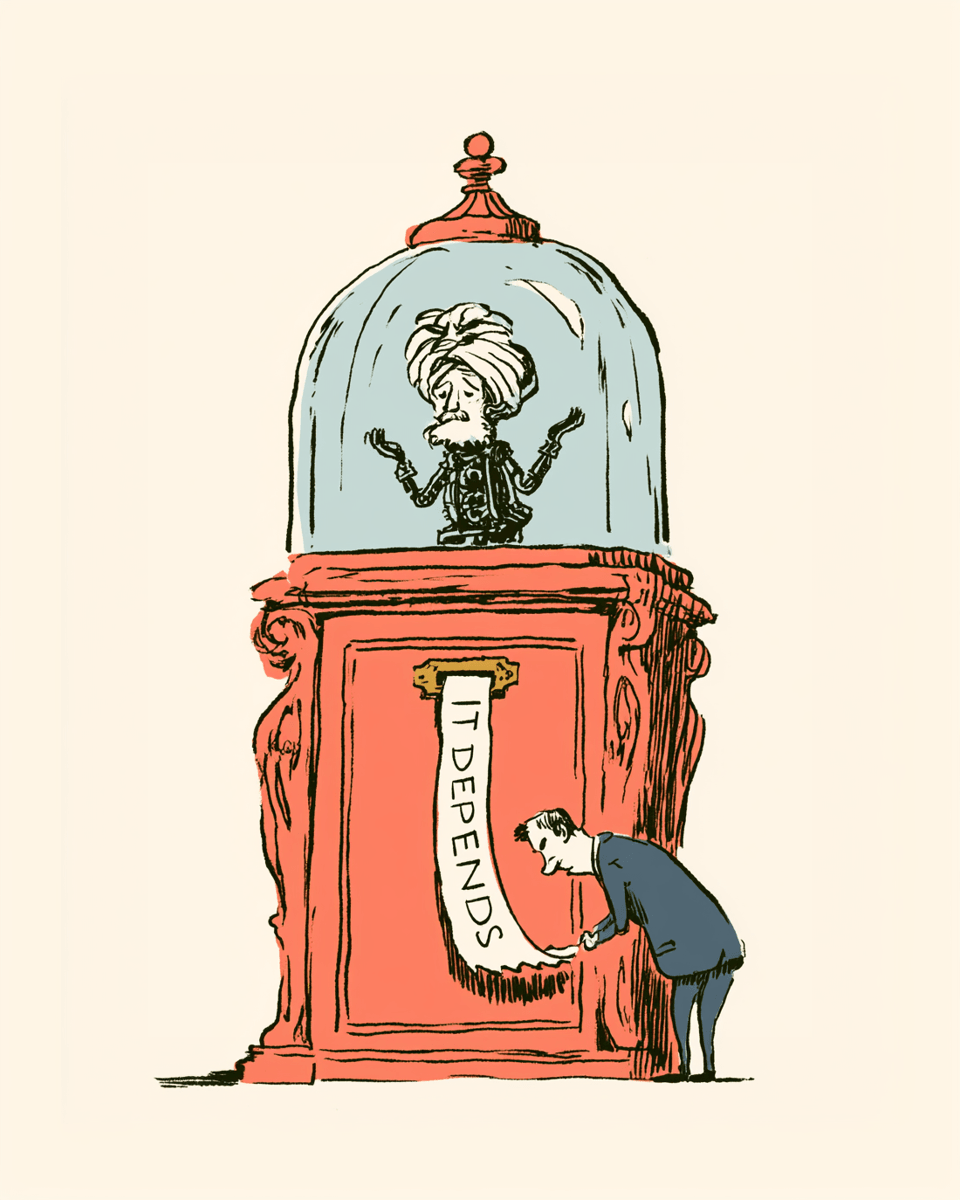
In performance marketing, the honest answer to almost everything is "it depends". Five counter-intuitive quirks of Meta's machine that punish instinct, reward patience, and quietly decide the P&L.